

Reactor Type Heat Exchanger

Reactor Type Heat Exchangers

Reactor Type Heat Exchanger
Reactor Type Heat Exchanger
Reactor Type Heat Exchangers
Reactor Type Heat Exchanger


High Pressure Shell and U Tube Heat Exchangers

Shell and U Tube Heat Exchanger High Pressure
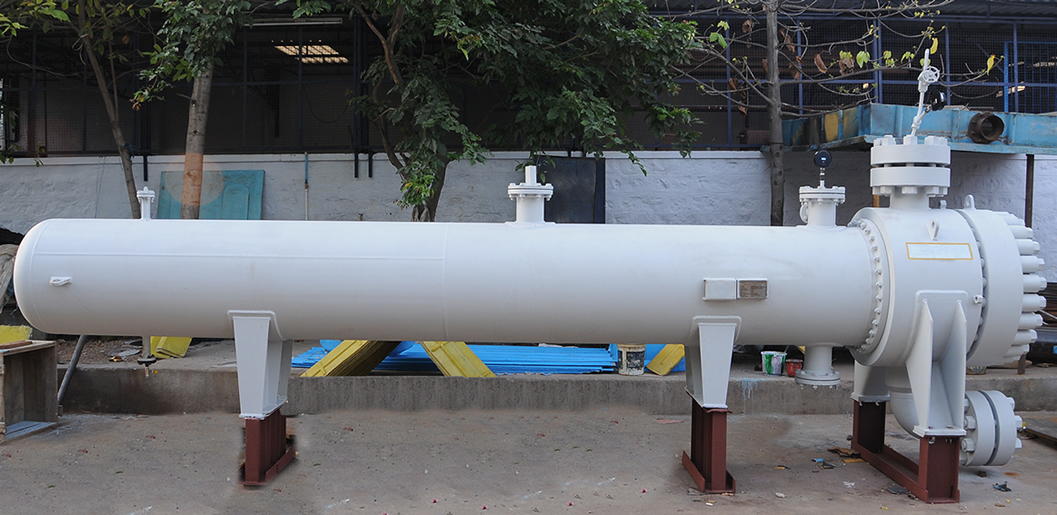
High Pressure Shell and U Tube Heat Exchanger


Stacked Type Shell and Tube Heat Exchanger

Stacked Shell and Tube Heat Exchanger

Stacked Type Shell and Tube Heat Exchanger

Stacked Type Heat Exchanger

Stacked Type Heat Exchangers

Evaporative Condensers :
In systems involving heat transfer, evaporative condenser is a device or unit used to condense a substance from its gaseous to its liquid state, by cooling it. In so doing, the latent heat is given up by the substance and transferred to the surrounding environment. Condensers can be made according to numerous designs, and come in many sizes ranging from rather small (hand-held) to very large (industrial-scale units used in plant processes).
For example, a refrigerator uses a condenser to get rid of heat extracted from the interior of the unit to the outside air. Evaporative Condensers are used in air conditioning, industrial chemical processes such as distillation, steam power plants and other heat-exchange systems. Use of cooling water or surrounding air as the coolant is common in many condensers.
An evaporative cooler (also swamp cooler, desert cooler and wet air cooler) is a device that cools air through the evaporation of water. Evaporative cooling differs from typical air conditioning systems, which use vapor-compression or absorption refrigeration cycles. Evaporative cooling works by exploiting water’s large enthalpy of vaporization. The temperature of dry air can be dropped significantly through the phase transition of liquid water to water vapor (evaporation). This can cool air using much less energy than refrigeration. In extremely dry climates, evaporative cooling of air has the added benefit of conditioning the air with more moisture for the comfort of building occupants.
The cooling potential for evaporative cooling is dependent on the wet-bulb depression, the difference between dry-bulb temperature and wet-bulb temperature. In arid climates, evaporative cooling can reduce energy consumption and total equipment for conditioning as an alternative to compressor-based cooling. In climates not considered arid, indirect evaporative cooling can still take advantage of the evaporative cooling process without increasing humidity. Passive evaporative cooling strategies offer the same benefits of mechanical evaporative cooling systems without the complexity of equipment and ductwork.
Air Cooled Closed Circuit Coolers
Indirect closed circuit (Air Cooled Closed Circuit Coolers) is a cooling process that uses direct air cooled closed circuit coolers, cooling in addition to some type of heat exchanger to transfer the cool energy to the supply air. The cooled moist air from the direct evaporative cooling process never comes in direct contact with the conditioned supply air. The moist air stream is released outside or used to cool other external devices such as solar cells which are more efficient if kept cool. One indirect cooler manufacturer uses the so-called Maisotsenko cycle which employs an iterative (multi-step) heat exchanger that can reduce the temperature of product air to below the wet-bulb temperature, and can a approach the dew point.[17] While no moisture is added to the incoming air the relative humidity (RH) does rise a little according to the Temperature-RH formula. Still, the relatively dry air resulting from indirect evaporative cooling allows inhabitants’ perspiration to evaporate more easily, increasing the relative effectiveness of this technique. Indirect Cooling is an effective strategy for hot-humid climates that cannot afford to increase the moisture content of the supply air due to indoor air quality and human thermal comfort concerns. The following graphs describe the process of direct and indirect evaporative cooling with the changes in temperature, moisture content and relative humidity of the air.
Passive indirect cooling strategies are rare because this strategy involves an architectural element to act as a heat exchanger (for example a roof). This element can be sprayed with water and cooled through the evaporation of the water on this element. These strategies are rare due to the high use of water, which also introduces the risk of water intrusion and compromising building structure.
Water heating is a thermodynamic process using an energy source to heat water above its initial temperature. Typical household uses of hot water are for cooking, cleaning, bathing, and space heating. In industry, both hot water and water heated to condensation have many uses.
Domestically, water is customarily heated in vessels known as water heaters, kettles, cauldrons, pots, or coppers. These metal vessels heat a batch of water, but do not produce a continual supply of heated water at a preset temperature. The temperature will vary based on the consumption rate of hot water; the water becomes cooler as flow is increased.
Appliances for providing a more-or-less stable supply of hot water are variously known as water heaters, hot water heaters, hot water tanks, boilers, heat exchangers, calorifiers, or geysers depending on whether they are heating filtered or non-potable water, in domestic or industrial use, their energy source, and in which part of the world they are found. In domestic installations, potable water heated for uses other than space heating is sometimes known as domestic hot water (DHW).
In many countries the most common energy sources for heating water are fossil fuels: natural gas, liquefied petroleum gas, oil, or sometimes-solid fuels. These fuels may be addicted directly or by the use of electricity (which may derive from any of the above fuels or from nuclear or renewable sources). Alternative energy such as solar energy, heat pumps, hot water heat recycling, and sometimes-geothermal heating, may also be used as available, usually in arrangement with backup systems supplied by gas, oil or electricity.
In some countries district heating is a main source of water heating in compactly populated urban areas. This is especially the case in Scandinavia. District heating systems make it possible to supply all of the energy for water heating as well as space heating from waste heat from industries, power plants, incinerators, geothermal heating, and central solar heating. The actual heating of the tap water is performed in heat exchangers at the consumers’ premises. Generally the consumer has no in-building backup system, due to the very high-expected accessibility of district heating systems.
Energy efficiencies of water heaters in residential use can vary greatly, particularly based on manufacturer and model. However, electric heaters tend to be slightly more efficient (if one omits the power station losses) with recovery efficiency (how efficiently energy is transferred to the water) reaching about 98%. Gas fired heaters have maximum recovery efficiencies of only about 86% (the remaining heat is lost with the flue gasses). Overall energy factors can be as low as 80% for electric and 50% for gas systems. Natural gas and propane tank water heaters with energy factors of 62% or greater, as well as electric tank water heaters with energy factors of 93% or greater, are considered high-efficiency units. Energy Star-rated natural gas and propane water heaters have energy factors of 67% or higher; electric tank water heaters are not included in the Energy Star program. Since electricity production itself today has efficiency levels ranging from only 15% to slightly over 55% (combined cycle gas turbine), with around 40% typical for thermal power stations, direct electric water heating is typically the least energy efficient option. However, use of a heat pump can make electric water heaters much more energy efficient and lead to a decrease in carbon dioxide emissions, even more so if a renewable source of electricity is used.


Vertical Shell and Tube Heat Exchanger
A Vertical Shell and Tube Heat Exchanger in which the tubes extend through oversized holes in a liquid distribution plate. Liquid flows through the holes and down each tube exterior surface as a falling film. A spacer or clip, desirably of wire, is placed in each hole around each tube to center the tube so that the film has a uniform thickness. The clip is self-locking and remains fixed securely in position. Vertical Shell and Tube Heat Exchanger is a heat exchanger that is derived from its parent Shell and Tube Heat Exchanger and it is most commonly all Industries which involves higher-pressure and Higher Temperature applications.
A set of tubes is called the tube bundle and can be made up of several types of tubes: plain, longitudinally finned, etc. Shell and tube heat exchangers are typically used for high-pressure applications (with pressures greater than 30 bar and temperatures greater than 260 °C).[2] This is because the shell and tube heat exchangers are robust due to their shape.
They are commonly used in


u tube bundle heat exchanger
A heat-exchanger system consisting of a bundle of U tubes (hairpin tubes) surrounded by a shell (outer vessel); one fluid flows through the tubes, and the other fluid flows through the shell, around the tubes.Multitherm can duplicate any existing bundle to include dimensions, materials and performance. we can build “U” tube bundles, straight tube “floating” tube bundles, or we can retube fixed tubesheet heat exchangers when the bundles is not removable. multitherm is not locked into any one material. Most bundles tend to be build with copper tubes and steel tubesheets.

u tube bundle heat exchanger
In nuclear power plants called pressurized water reactors, large heat exchangers called steam generators are two-phase, shell-and-tube heat exchangers which typically have U-tubes. They are used to boil water recycled from a surface condenser into steam to drive a turbine to produce power. Most shell-and-tube heat exchangers are either 1, 2, or 4 pass designs on the tube side.

